Tool to translate/write with the Celestial alphabet, a series of occult symbols described by Heinrich Cornelius Agrippa, based on Hebrew.
Celestial Alphabet - dCode
Tag(s) : Symbol Substitution

dCode is free and its tools are a valuable help in games, maths, geocaching, puzzles and problems to solve every day!
A suggestion ? a feedback ? a bug ? an idea ? Write to dCode!
Celestial Alphabet
Celestial Decoder
Celestial Encoder
Answers to Questions (FAQ)
What is the Celestial alphabet? (Definition)
The Celestial Alphabet is an esoteric alphabet described by Henri-Corneille Agrippa of Nettesheim in his work De occulta philosophia (On Occult Philosophy), published in the 16th century.
In Book III, page 439, Agrippa presents this alphabet as a so-called angelic script, composed of symbols believed to possess mystical value. Here is an excerpt from the original manuscript: 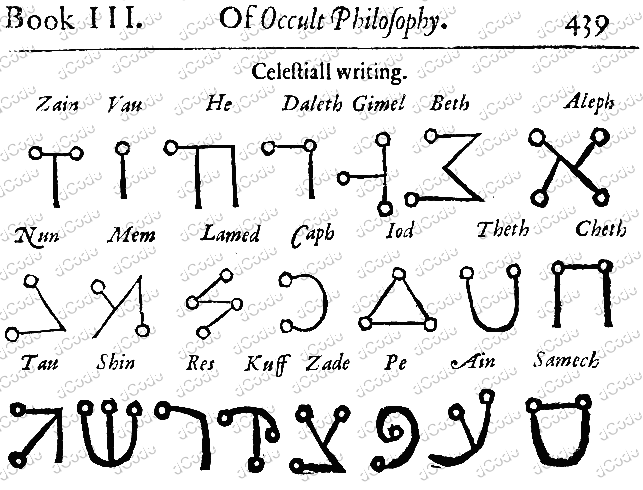
How to encrypt using Celestial alphabet/cipher?
Writing text with the Celestial script involves replacing each Hebrew letter with its corresponding Celestial glyph.
A transliteration is therefore necessary to encrypt a word or a sentence from the Latin alphabet (our usual alphabet).
Example: The letter A is transcribed with the Hebrew letter Aleph (א), likewise, the letter B with Beth (ב), etc. However, this association is not always possible (there are only 22 Hebrew letters against 26 Latin letters).
Example: CELESTIAL is transcribed גהלהשתיאל or .png)
.png)
.png)
.png)
.png)
.png)
.png)
Reminder: Hebrew, and therefore Celestial script, is read from right to left.
How to decrypt Celestial alphabet/cipher?
Decoding a text written in Celestial involves replacing each Celestial glyph with the corresponding Hebrew letter, then transliterating the Hebrew into the Latin/English alphabet.
This process is not always straightforward: certain Hebrew characters do not have an equivalent in our Latin alphabet (such as ט or צ), and there are even letters Hebrew with several possible transliterations (like ג for C or G, י for I or J or even ו for F, V or U).
Example: .png) becomes אנגהליג or ANGELIC
becomes אנגהליג or ANGELIC
Reminder: the Hebrew scriptures are read from right to left.
How to recognize a Celestial ciphertext?
The characters of the Celestial alphabet are distinguished by geometric shapes composed of straight (sometimes curved) lines/sticks ending in solid circles reminiscent of stellar points/stars.
This graphic appearance evokes a constellation map, hence the name Celestial.
References to magic, angels, Kabbalah, or Renaissance esotericism are often clues to its presence.
Note: the Malachim and Passage du Fleuve (or Passing the River) alphabets are visually very similar and come from the same Kabbalistic tradition.
When was Celestial invented?
The publication of Heinrich Cornelius Agrippa's book dates from the 16th century.
The exact author of this alphabet is not known. It could be a creation of Agrippa himself or an adaptation of an older source.
Source code
dCode retains ownership of the "Celestial Alphabet" source code. Any algorithm for the "Celestial Alphabet" algorithm, applet or snippet or script (converter, solver, encryption / decryption, encoding / decoding, ciphering / deciphering, breaker, translator), or any "Celestial Alphabet" functions (calculate, convert, solve, decrypt / encrypt, decipher / cipher, decode / encode, translate) written in any informatic language (Python, Java, PHP, C#, Javascript, Matlab, etc.) or any database download or API access for "Celestial Alphabet" or any other element are not public (except explicit open source licence). Same with the download for offline use on PC, mobile, tablet, iPhone or Android app.
Reminder: dCode is an educational and teaching resource, accessible online for free and for everyone.
Cite dCode
The content of the page "Celestial Alphabet" and its results may be freely copied and reused, including for commercial purposes, provided that dCode.fr is cited as the source (Creative Commons CC-BY free distribution license).
Exporting the results is free and can be done simply by clicking on the export icons ⤓ (.csv or .txt format) or ⧉ (copy and paste).
To cite dCode.fr on another website, use the link:
In a scientific article or book, the recommended bibliographic citation is: Celestial Alphabet on dCode.fr [online website], retrieved on 2026-09-28,