Tool to decrypt/encrypt with T9 mode (predictive) for SMS text messages for (old) mobile phones or numeric keypads.
T9 (Text Message) - dCode
Tag(s) : Telecom, Substitution Cipher

dCode is free and its tools are a valuable help in games, maths, geocaching, puzzles and problems to solve every day!
A suggestion ? a feedback ? a bug ? an idea ? Write to dCode!
T9 (Text Message)
T9 Decoder/Phonewords Finder
T9 vs Multitap Confusion
T9 mode should not be confused with Multitap ABC mode. 'DCODE' is written as '32633' in T9 but '3222666333' in Multitap.
T9 Encoder
Textonym list
Answers to Questions (FAQ)
What is T9? (Definition)
T9 (Text on 9 keys) is a predictive text system that allows you to type words by pressing each letter once on a phone's keypad.
It relies on a dictionary and an algorithm that guesses the most likely word based on the sequence of keys typed by the user.
How to encrypt using T9 cipher?
To encode a message with the T9, each letter is replaced by the number of the key that contains it on the keypad:
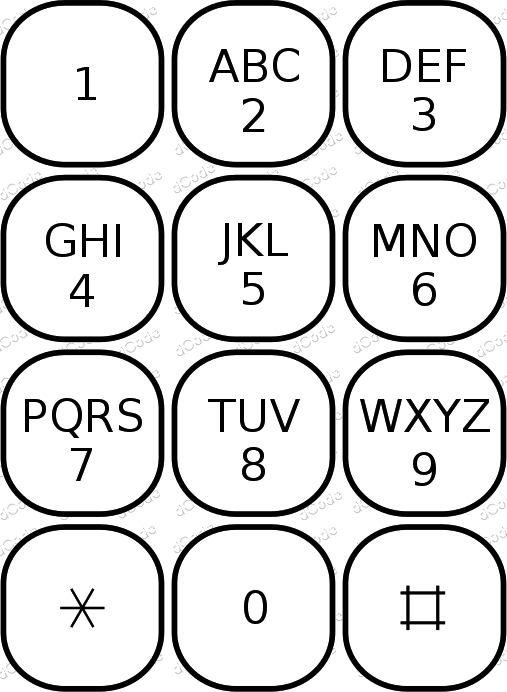
The user presses only once per letter.
Example: DCODE becomes 32633 on a T9 keyboard
Do not confuse the T9 with the multi-tap code (successively press the keys until you get the correct letter)
How to decrypt T9 cipher?
T9 decoding is based on a dictionary: the sequence of numbers is compared to all known entries, and then the most probable word is suggested.
Without a dictionary, it is possible to perform an exhaustive search: each digit $ k $ corresponds to 3 or 4 letters, so a sequence can represent several combinations.
Example: 22 can yield AA,AB,AC,BA,BB,BC,CA,CB,CC
The code is sometimes used to create phonewords (mnemonic words for telephone numbers).
How to recognize T9 ciphertext?
T9 encoding is recognizable because the message consists mainly of numbers containing the digits 2 to 9; the 0s and 1s are generally used for spaces or punctuation.
The T9 had other proprietary trade names like iTap, XT9, LetterWise or WordWise.
The notions of SMS writing/language or texting or autocorrect are clues as well as old mobile phones like Nokia 3210.
What are the variants of the T9 cipher?
T9 differs from Multitap (ABC mode), a non-predictive method where the user presses the same key multiple times to obtain the correct letter.
Example: With this mode, DCODE is written as 3222666333
What is a Textonym?
A textonym is a word that shares the exact same T9 key sequence as another word (encoding collision).
Example: COOL and BOOK are both encoded as 2665
These collisions are unavoidable because multiple letters are associated with the same key.
When was T9 invented?
T9 was developed and patented in the mid-1990s by Tegic Communications. It gained popularity with the rise of SMS messaging on mobile phones in the late 1990s and early 2000s.
With the advent of smartphones with full touchscreen keyboards (Android and iPhone type), its use declined sharply, but it remains a useful way to encode messages.
Source code
dCode retains ownership of the "T9 (Text Message)" source code. Any algorithm for the "T9 (Text Message)" algorithm, applet or snippet or script (converter, solver, encryption / decryption, encoding / decoding, ciphering / deciphering, breaker, translator), or any "T9 (Text Message)" functions (calculate, convert, solve, decrypt / encrypt, decipher / cipher, decode / encode, translate) written in any informatic language (Python, Java, PHP, C#, Javascript, Matlab, etc.) or any database download or API access for "T9 (Text Message)" or any other element are not public (except explicit open source licence). Same with the download for offline use on PC, mobile, tablet, iPhone or Android app.
Reminder: dCode is an educational and teaching resource, accessible online for free and for everyone.
Cite dCode
The content of the page "T9 (Text Message)" and its results may be freely copied and reused, including for commercial purposes, provided that dCode.fr is cited as the source (Creative Commons CC-BY free distribution license).
Exporting the results is free and can be done simply by clicking on the export icons ⤓ (.csv or .txt format) or ⧉ (copy and paste).
To cite dCode.fr on another website, use the link:
In a scientific article or book, the recommended bibliographic citation is: T9 (Text Message) on dCode.fr [online website], retrieved on 2026-10-05,