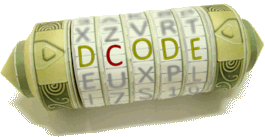
Tool to decrypt/encrypt using a scytale (a stick), a transposition cipher used in ancient Greece and by spartans.
Scytale Cipher - dCode
Tag(s) : Transposition Cipher

dCode is free and its tools are a valuable help in games, maths, geocaching, puzzles and problems to solve every day!
A suggestion ? a feedback ? a bug ? an idea ? Write to dCode!
Scytale Cipher
Scytale Decoder
Scytale Encoder
Answers to Questions (FAQ)
What is a scytale? (Definition)
A scytale is a transposition cipher used in ancient Greece, particularly in Sparta. It consists of a cylindrical rod around which a ribbon (often made of leather or parchment) is wound.
The message is written along the rod, following the spiral formed by the ribbon. Once the ribbon is unwound, the letters appear in a different order: the text becomes unintelligible without a rod of the same diameter.
The cipher known as the Caesar box has a different design but produces the exact same encrypted message, the method is also called rectangular transposition.
How to encrypt using a Scytale?
Scytale Encryption uses a cylinder and a band characterized by its number of turns L (height) of the band around the cylinder of width/wideness (l).
Example: Code DCODE with a band L=3.
The message is written along the cylinder, one letter per band, and when the end is reached, go to a new line.
If needed, complete the last row with another character, e.g. X or _.
Example:
| DCO |
| DE_ |
The ciphered message is the band unrolled, (i.e the message read by column).
Example: The cipher text is DDCEO_
How to decrypt a Scytale ciphertext?
Scytale Decryption requires to know the number N of letters by turn of the band (the size of the cylinder), or L the number of turns around the cylinder.
Example: The ciphertext is DDCEO_ (6-character long) and the band is L=3, then N=2 (because 6/3=2).
Write the message on the band and wraps the band around the cylinder (of correct size) and the plain text should appear.
Example:
| DCO |
| DE_ |
Remove the final filler character if necessary.
How to wrap the paper band?
To make a scytale, wind a strip of paper or parchment in a regular spiral around a cylinder (straight rod, tool handle, rigid tube).
The spirals must be close together and not overlap. The diameter of the cylinder is key: a cylinder of a different diameter will produce a different arrangement of the letters.
What is the Plutarch's staff?
The Plutarch's staff is another name for the scytale. The technique is described by the Greek philosopher Plutarch in his historical writings, notably in Parallel Lives.
He is not necessarily the inventor, but one of the main ancient sources describing this technique used by the Spartans.
How to recognize Scytale ciphertext?
The coincidence index is equal to the one of the original text (as it is a transposition cipher).
The message length should not be a prime number, but should have several divisors (including N the number of letters per ribbon turn and L the number of ribbon turns)
Any synonym of stick, rod, cane, cylinder, whorl, reel, roll, etc. is a clue.
The plutarch's staff is the name given to an album of Blake and Mortimer.
Any references to Greece, Sparta or the Spartans are clues.
Skytale is the direct Greek transliteration for skutalè
The Greek general Lysander and the ephors (Spartan magistrates) are described by Plutarch as users of scytales.
How to decipher Scytale without the size?
One can crack Scytale by testing all possible size of the rectangle.
For a message of length M, the only possible dimensions are the pairs of factors L and N such that L x N = M.
An attacker would therefore have to try each divisor of M and analyze whether the resulting text is intelligible.
When was Scytale invented?
The scytale is believed to have been used in Sparta between the 8th and 5th centuries BC, although written sources are later (the technique is described in the 1st century AD by Plutarch).
The exact date of its invention remains unknown, but its use is generally associated with the Greek Classical period.
Source code
dCode retains ownership of the "Scytale Cipher" source code. Any algorithm for the "Scytale Cipher" algorithm, applet or snippet or script (converter, solver, encryption / decryption, encoding / decoding, ciphering / deciphering, breaker, translator), or any "Scytale Cipher" functions (calculate, convert, solve, decrypt / encrypt, decipher / cipher, decode / encode, translate) written in any informatic language (Python, Java, PHP, C#, Javascript, Matlab, etc.) or any database download or API access for "Scytale Cipher" or any other element are not public (except explicit open source licence). Same with the download for offline use on PC, mobile, tablet, iPhone or Android app.
Reminder: dCode is an educational and teaching resource, accessible online for free and for everyone.
Cite dCode
The content of the page "Scytale Cipher" and its results may be freely copied and reused, including for commercial purposes, provided that dCode.fr is cited as the source (Creative Commons CC-BY free distribution license).
Exporting the results is free and can be done simply by clicking on the export icons ⤓ (.csv or .txt format) or ⧉ (copy and paste).
To cite dCode.fr on another website, use the link:
In a scientific article or book, the recommended bibliographic citation is: Scytale Cipher on dCode.fr [online website], retrieved on 2026-03-28,